Showing posts with label Komatsu Mining System. Show all posts

Wednesday, November 17, 2010

The Komatsu Komtrax System


Keeping track of equipment in the field is a difficult but very necessary part of your job. Whether you are providing service and maintenance for the customers who’ve purchased equipment in your territory, or you are managing a fleet of rental machines, you need to know where that equipment is and what it’s doing.

The Challenge of Managing Machines

Critical service opportunities can come and go and you won’t know they’ve been missed until the next time you see the equipment. Even when you do know that service is due, your service vehicles can waste valuable time searching for machines in the field. When repairs are needed, your customers expect accurate ETA’s for your service crews, even if they’re not sure precisely where the equipment is.

For rental fleets, the need to know the location and status of your equipment is vital to running an efficient operation. Scheduling pickups, drop-offs, and service depends on knowing where the equipment needs to be and when.

You know the service hour meter reading when the equipment goes out and when it comes back, but while it’s out there, you can only guess. And nothing is more frustrating than being unable to locate your equipment
when you need to. It’s almost always a simple miscommunication between the renter and you. But when it’s not, you could have a long search ahead.


GPS Satellite Provides positioning information to the Komtrax unit in the field

The Komatsu Komtrax system is a revolutionary new way for you to monitor the equipment in your territory. It begins with a multifunctional transmitting unit installed on each machine. Through a system of GPS and telecommunication satellites, you can now pinpoint the precise location of any of those pieces of equipment, and get real-time service hour meter readings from them with Internet Explorer® over any Internet connection.

The system includes powerful management software designed especially for the construction industry. With the appropriate maps installed, the Komtrax system can accurately display the equipment’s relative position in your neighborhood, or across the globe. In addition to monitoring equipment right from your desktop, you can collect trending information for the operating patterns of your customers. You can also specify options, such as how often the system updates the positioning and service hour meter information.


The hardware components of the Komtrax system are built to withstand the harshest construction environments. Tested extensively in working conditions around the world, the units include such reliability features as an automatic wake-up function that keeps transmitting even when the machine’s engine is not running. The system will soon be available as a factory-installed option or as an easy-to-install retro fit package.

It’s been designed to grow with the capabilities of the Komtrax system. As more features become available, you will be better prepared for future enhancements.

Knowing where your customer’s equipment is and what its service hour meter reading is brings a new level of efficiency, productivity and service to your company. You can tell at a glance what and where your customers are operating. Knowing when your customers are approaching important service intervals, you can proactively suggest maintenance, and then schedule the service at their convenience according to the operation trends you collected. With the GPS locating capability, your technicians will know precisely where to find the equipment, saving time and money.

When rental equipment is out in the field, you can instantly tell if your equipment is being used where it is supposed to be, and track the service hour meter readings to determine if the hours in the rental contract are being exceeded. Back at the office, the Komtrax system makes scheduling of rentals much easier. Equipment drop-offs, pickups, and service can be planned efficiently when you know where to send your trucks ahead of time. 

Maintenance of the equipment can be performed during periods of inactivity, which you can determine through the trending features of the system. With worldwide GPS coverage, any machines that are lost or stolen can quickly be located, making recovery much easier, saving your equipment and your time. The Komtrax system also contains a remote engine cut off function that prohibits starting the engine for additional vandalism and theft protection.

The Future
There are many exciting and productive features planned for the Komtrax system. A service truck package will be available that will equip your service fleet with the same GPS locating ability, as well as several other important features. Service technicians will be able to track the position of the equipment they are searching for right from their vehicles. They will be able to indicate their progress on the job as they travel to the site, and while they work on the equipment. With this information constantly being updated, you will be able to provide precise ETA’s for service or maintenance work to your customers.

Expanded telemetry from the equipment in the field is also in the works. The machines will transmit many important system readings, including engine speed, fuel levels, oil pressure, battery voltage, operation mode, and more. Any error codes that the machine might report will be visible on your system, allowing you to remotely diagnose the equipment or give your service technicians critical information (such as what parts or specialized tools to bring) to prepare them for performing any repairs.

What Now?
This exciting new technology is available now. The Komatsu Komtrax system is already being introduced to machines across the country. Contact Komatsu today and find out about this powerful new management tool that will boost your levels of productivity and service.

  • Locate machines instantly through GPS system 
  • Get real-time service hour meter readings 
  • Know in advance when maintenance is due 
  • Plan maintenance by customers’ usage patterns 
  • Schedule equipment usage more effectively
  • Track lost or stolen equipment
  • Expanded functionality planned for the future

The Komtrax system hardware can be removed from any piece of equipment and installed on another. Additionally, equipment outfitted with the Komtrax system will see an increase in resale value. A continually updated operation history makes a very attractive feature when the time comes to sell equipment. And as the Komtrax system becomes the standard, customers will request used equipment with the hardware already in place.


The Komatsu Komtrax System


Keeping track of equipment in the field is a difficult but very necessary part of your job. Whether you are providing service and maintenance for the customers who’ve purchased equipment in your territory, or you are managing a fleet of rental machines, you need to know where that equipment is and what it’s doing.

The Challenge of Managing Machines

Critical service opportunities can come and go and you won’t know they’ve been missed until the next time you see the equipment. Even when you do know that service is due, your service vehicles can waste valuable time searching for machines in the field. When repairs are needed, your customers expect accurate ETA’s for your service crews, even if they’re not sure precisely where the equipment is.

For rental fleets, the need to know the location and status of your equipment is vital to running an efficient operation. Scheduling pickups, drop-offs, and service depends on knowing where the equipment needs to be and when.

You know the service hour meter reading when the equipment goes out and when it comes back, but while it’s out there, you can only guess. And nothing is more frustrating than being unable to locate your equipment
when you need to. It’s almost always a simple miscommunication between the renter and you. But when it’s not, you could have a long search ahead.


GPS Satellite Provides positioning information to the Komtrax unit in the field

The Komatsu Komtrax system is a revolutionary new way for you to monitor the equipment in your territory. It begins with a multifunctional transmitting unit installed on each machine. Through a system of GPS and telecommunication satellites, you can now pinpoint the precise location of any of those pieces of equipment, and get real-time service hour meter readings from them with Internet Explorer® over any Internet connection.

The system includes powerful management software designed especially for the construction industry. With the appropriate maps installed, the Komtrax system can accurately display the equipment’s relative position in your neighborhood, or across the globe. In addition to monitoring equipment right from your desktop, you can collect trending information for the operating patterns of your customers. You can also specify options, such as how often the system updates the positioning and service hour meter information.


The hardware components of the Komtrax system are built to withstand the harshest construction environments. Tested extensively in working conditions around the world, the units include such reliability features as an automatic wake-up function that keeps transmitting even when the machine’s engine is not running. The system will soon be available as a factory-installed option or as an easy-to-install retro fit package.

It’s been designed to grow with the capabilities of the Komtrax system. As more features become available, you will be better prepared for future enhancements.

Knowing where your customer’s equipment is and what its service hour meter reading is brings a new level of efficiency, productivity and service to your company. You can tell at a glance what and where your customers are operating. Knowing when your customers are approaching important service intervals, you can proactively suggest maintenance, and then schedule the service at their convenience according to the operation trends you collected. With the GPS locating capability, your technicians will know precisely where to find the equipment, saving time and money.

When rental equipment is out in the field, you can instantly tell if your equipment is being used where it is supposed to be, and track the service hour meter readings to determine if the hours in the rental contract are being exceeded. Back at the office, the Komtrax system makes scheduling of rentals much easier. Equipment drop-offs, pickups, and service can be planned efficiently when you know where to send your trucks ahead of time. 

Maintenance of the equipment can be performed during periods of inactivity, which you can determine through the trending features of the system. With worldwide GPS coverage, any machines that are lost or stolen can quickly be located, making recovery much easier, saving your equipment and your time. The Komtrax system also contains a remote engine cut off function that prohibits starting the engine for additional vandalism and theft protection.

The Future
There are many exciting and productive features planned for the Komtrax system. A service truck package will be available that will equip your service fleet with the same GPS locating ability, as well as several other important features. Service technicians will be able to track the position of the equipment they are searching for right from their vehicles. They will be able to indicate their progress on the job as they travel to the site, and while they work on the equipment. With this information constantly being updated, you will be able to provide precise ETA’s for service or maintenance work to your customers.

Expanded telemetry from the equipment in the field is also in the works. The machines will transmit many important system readings, including engine speed, fuel levels, oil pressure, battery voltage, operation mode, and more. Any error codes that the machine might report will be visible on your system, allowing you to remotely diagnose the equipment or give your service technicians critical information (such as what parts or specialized tools to bring) to prepare them for performing any repairs.

What Now?
This exciting new technology is available now. The Komatsu Komtrax system is already being introduced to machines across the country. Contact Komatsu today and find out about this powerful new management tool that will boost your levels of productivity and service.

  • Locate machines instantly through GPS system 
  • Get real-time service hour meter readings 
  • Know in advance when maintenance is due 
  • Plan maintenance by customers’ usage patterns 
  • Schedule equipment usage more effectively
  • Track lost or stolen equipment
  • Expanded functionality planned for the future

The Komtrax system hardware can be removed from any piece of equipment and installed on another. Additionally, equipment outfitted with the Komtrax system will see an increase in resale value. A continually updated operation history makes a very attractive feature when the time comes to sell equipment. And as the Komtrax system becomes the standard, customers will request used equipment with the hardware already in place.


The Komatsu Komtrax System


Keeping track of equipment in the field is a difficult but very necessary part of your job. Whether you are providing service and maintenance for the customers who’ve purchased equipment in your territory, or you are managing a fleet of rental machines, you need to know where that equipment is and what it’s doing.

The Challenge of Managing Machines

Critical service opportunities can come and go and you won’t know they’ve been missed until the next time you see the equipment. Even when you do know that service is due, your service vehicles can waste valuable time searching for machines in the field. When repairs are needed, your customers expect accurate ETA’s for your service crews, even if they’re not sure precisely where the equipment is.

For rental fleets, the need to know the location and status of your equipment is vital to running an efficient operation. Scheduling pickups, drop-offs, and service depends on knowing where the equipment needs to be and when.

You know the service hour meter reading when the equipment goes out and when it comes back, but while it’s out there, you can only guess. And nothing is more frustrating than being unable to locate your equipment
when you need to. It’s almost always a simple miscommunication between the renter and you. But when it’s not, you could have a long search ahead.


GPS Satellite Provides positioning information to the Komtrax unit in the field

The Komatsu Komtrax system is a revolutionary new way for you to monitor the equipment in your territory. It begins with a multifunctional transmitting unit installed on each machine. Through a system of GPS and telecommunication satellites, you can now pinpoint the precise location of any of those pieces of equipment, and get real-time service hour meter readings from them with Internet Explorer® over any Internet connection.

The system includes powerful management software designed especially for the construction industry. With the appropriate maps installed, the Komtrax system can accurately display the equipment’s relative position in your neighborhood, or across the globe. In addition to monitoring equipment right from your desktop, you can collect trending information for the operating patterns of your customers. You can also specify options, such as how often the system updates the positioning and service hour meter information.


The hardware components of the Komtrax system are built to withstand the harshest construction environments. Tested extensively in working conditions around the world, the units include such reliability features as an automatic wake-up function that keeps transmitting even when the machine’s engine is not running. The system will soon be available as a factory-installed option or as an easy-to-install retro fit package.

It’s been designed to grow with the capabilities of the Komtrax system. As more features become available, you will be better prepared for future enhancements.

Knowing where your customer’s equipment is and what its service hour meter reading is brings a new level of efficiency, productivity and service to your company. You can tell at a glance what and where your customers are operating. Knowing when your customers are approaching important service intervals, you can proactively suggest maintenance, and then schedule the service at their convenience according to the operation trends you collected. With the GPS locating capability, your technicians will know precisely where to find the equipment, saving time and money.

When rental equipment is out in the field, you can instantly tell if your equipment is being used where it is supposed to be, and track the service hour meter readings to determine if the hours in the rental contract are being exceeded. Back at the office, the Komtrax system makes scheduling of rentals much easier. Equipment drop-offs, pickups, and service can be planned efficiently when you know where to send your trucks ahead of time. 

Maintenance of the equipment can be performed during periods of inactivity, which you can determine through the trending features of the system. With worldwide GPS coverage, any machines that are lost or stolen can quickly be located, making recovery much easier, saving your equipment and your time. The Komtrax system also contains a remote engine cut off function that prohibits starting the engine for additional vandalism and theft protection.

The Future
There are many exciting and productive features planned for the Komtrax system. A service truck package will be available that will equip your service fleet with the same GPS locating ability, as well as several other important features. Service technicians will be able to track the position of the equipment they are searching for right from their vehicles. They will be able to indicate their progress on the job as they travel to the site, and while they work on the equipment. With this information constantly being updated, you will be able to provide precise ETA’s for service or maintenance work to your customers.

Expanded telemetry from the equipment in the field is also in the works. The machines will transmit many important system readings, including engine speed, fuel levels, oil pressure, battery voltage, operation mode, and more. Any error codes that the machine might report will be visible on your system, allowing you to remotely diagnose the equipment or give your service technicians critical information (such as what parts or specialized tools to bring) to prepare them for performing any repairs.

What Now?
This exciting new technology is available now. The Komatsu Komtrax system is already being introduced to machines across the country. Contact Komatsu today and find out about this powerful new management tool that will boost your levels of productivity and service.

  • Locate machines instantly through GPS system 
  • Get real-time service hour meter readings 
  • Know in advance when maintenance is due 
  • Plan maintenance by customers’ usage patterns 
  • Schedule equipment usage more effectively
  • Track lost or stolen equipment
  • Expanded functionality planned for the future

The Komtrax system hardware can be removed from any piece of equipment and installed on another. Additionally, equipment outfitted with the Komtrax system will see an increase in resale value. A continually updated operation history makes a very attractive feature when the time comes to sell equipment. And as the Komtrax system becomes the standard, customers will request used equipment with the hardware already in place.


The Komatsu Komtrax System


Keeping track of equipment in the field is a difficult but very necessary part of your job. Whether you are providing service and maintenance for the customers who’ve purchased equipment in your territory, or you are managing a fleet of rental machines, you need to know where that equipment is and what it’s doing.

The Challenge of Managing Machines

Critical service opportunities can come and go and you won’t know they’ve been missed until the next time you see the equipment. Even when you do know that service is due, your service vehicles can waste valuable time searching for machines in the field. When repairs are needed, your customers expect accurate ETA’s for your service crews, even if they’re not sure precisely where the equipment is.

For rental fleets, the need to know the location and status of your equipment is vital to running an efficient operation. Scheduling pickups, drop-offs, and service depends on knowing where the equipment needs to be and when.

You know the service hour meter reading when the equipment goes out and when it comes back, but while it’s out there, you can only guess. And nothing is more frustrating than being unable to locate your equipment
when you need to. It’s almost always a simple miscommunication between the renter and you. But when it’s not, you could have a long search ahead.


GPS Satellite Provides positioning information to the Komtrax unit in the field

The Komatsu Komtrax system is a revolutionary new way for you to monitor the equipment in your territory. It begins with a multifunctional transmitting unit installed on each machine. Through a system of GPS and telecommunication satellites, you can now pinpoint the precise location of any of those pieces of equipment, and get real-time service hour meter readings from them with Internet Explorer® over any Internet connection.

The system includes powerful management software designed especially for the construction industry. With the appropriate maps installed, the Komtrax system can accurately display the equipment’s relative position in your neighborhood, or across the globe. In addition to monitoring equipment right from your desktop, you can collect trending information for the operating patterns of your customers. You can also specify options, such as how often the system updates the positioning and service hour meter information.


The hardware components of the Komtrax system are built to withstand the harshest construction environments. Tested extensively in working conditions around the world, the units include such reliability features as an automatic wake-up function that keeps transmitting even when the machine’s engine is not running. The system will soon be available as a factory-installed option or as an easy-to-install retro fit package.

It’s been designed to grow with the capabilities of the Komtrax system. As more features become available, you will be better prepared for future enhancements.

Knowing where your customer’s equipment is and what its service hour meter reading is brings a new level of efficiency, productivity and service to your company. You can tell at a glance what and where your customers are operating. Knowing when your customers are approaching important service intervals, you can proactively suggest maintenance, and then schedule the service at their convenience according to the operation trends you collected. With the GPS locating capability, your technicians will know precisely where to find the equipment, saving time and money.

When rental equipment is out in the field, you can instantly tell if your equipment is being used where it is supposed to be, and track the service hour meter readings to determine if the hours in the rental contract are being exceeded. Back at the office, the Komtrax system makes scheduling of rentals much easier. Equipment drop-offs, pickups, and service can be planned efficiently when you know where to send your trucks ahead of time. 

Maintenance of the equipment can be performed during periods of inactivity, which you can determine through the trending features of the system. With worldwide GPS coverage, any machines that are lost or stolen can quickly be located, making recovery much easier, saving your equipment and your time. The Komtrax system also contains a remote engine cut off function that prohibits starting the engine for additional vandalism and theft protection.

The Future
There are many exciting and productive features planned for the Komtrax system. A service truck package will be available that will equip your service fleet with the same GPS locating ability, as well as several other important features. Service technicians will be able to track the position of the equipment they are searching for right from their vehicles. They will be able to indicate their progress on the job as they travel to the site, and while they work on the equipment. With this information constantly being updated, you will be able to provide precise ETA’s for service or maintenance work to your customers.

Expanded telemetry from the equipment in the field is also in the works. The machines will transmit many important system readings, including engine speed, fuel levels, oil pressure, battery voltage, operation mode, and more. Any error codes that the machine might report will be visible on your system, allowing you to remotely diagnose the equipment or give your service technicians critical information (such as what parts or specialized tools to bring) to prepare them for performing any repairs.

What Now?
This exciting new technology is available now. The Komatsu Komtrax system is already being introduced to machines across the country. Contact Komatsu today and find out about this powerful new management tool that will boost your levels of productivity and service.

  • Locate machines instantly through GPS system 
  • Get real-time service hour meter readings 
  • Know in advance when maintenance is due 
  • Plan maintenance by customers’ usage patterns 
  • Schedule equipment usage more effectively
  • Track lost or stolen equipment
  • Expanded functionality planned for the future

The Komtrax system hardware can be removed from any piece of equipment and installed on another. Additionally, equipment outfitted with the Komtrax system will see an increase in resale value. A continually updated operation history makes a very attractive feature when the time comes to sell equipment. And as the Komtrax system becomes the standard, customers will request used equipment with the hardware already in place.


Monday, November 8, 2010

Earthmoving Data

SOIL CLASSIFICATION FOR EARTH-MOVING OPERATIONS
Various classifications have been established properly for soil depending on the purposes of earth-moving operations. Generally speaking, however, detailed classifications of soil are not required for the ordinary earth-moving operations.

Rather, attention is required to be given to whether the soil to be handled is of special ores or contains special
clay minerals. Hereinafter is described the knowledge necessary for earth work planning prior to such operations as digging, loading, hauling, pushing (spreading), rolling compaction, etc., on ordinary terrain.

* Data (figures) to be given hereinafter vary largely depending on various operating and environmental conditions. Consequently, before starting the earth work, tests should be conducted to obtain correct data for operations.

Some knowledge of the weight data per unit volume of materials of their major ingredients is important for their handling or hauling in mines, etc.. The specific weight data of some major types of soil and ingredients are given below.

WEIGHT DATA OF MATERIALS


Hauling Performance of Construction Machines
HAULING PERFORMANCE OF CONSTRUCTION MACHINES
INTRODUCTION
"What Model or type of a tractor is most suitable to pull this trailer?" "Is this bulldozer capable of going up this hill while pulling that scraper loaded full?" In order to give explicit answers to these questions, it is necessary to have the right understanding of the hauling performance of vehicles.


For easy understanding, let us explain the hauling performance with the following machine capabilities and
related elements.
(1) The inherent machine capability
(2) Elements limiting the inherent machine capability
(3) Machine capabilities required for earthmoving operations

INHERENT MACHINE CAPABILITY
1. What is the inherent machine capability?
a) Output power
The engine horsepower of a construction machine is the most essential power of those developed by the machine itself. This can be estimated by multiplying one element (traction force) by another element (a travel speed). Accordingly, where the engine of a machine develops a rated power; the smaller the travel speed, the larger the traction force or drawbar pull will be. On the contrary, the larger the travel speed, the smaller the drawbar pull.

b) Gear-shifting
Gear-shifting is effected to determine the optimum drawbar pull and travel speed required for accomplishing a given job. Therefore, a machine has several gears to be selected by shifting for the optimum travel speed.

2. Direct-drive type tractor
The table below gives the drawbar pull and travel speeds of a direct-drive type bulldozer.


The rated drawbar pull is such a traction force that can be developed at the rated engine power and the rated revolutions (rpm). The rated drawbar pull is normally estimated by taking into account the travelling resistance (which will be explained later) and the mechanical loss of power in its line from the engine to the sprockets.

The maximum drawbar pull is the maximum traction force that can be developed by a machine and is estimated from the maximum engine torque. In other words, the maximum drawbar pull of a machine can be developed by the lugging ability of its prime mover and is practically obtained in a low gear. Consequently, the maximum drawbar pull is shown only at F1 on the specifications.

3. TORQFLOW-drive type tractor
In a TORQFLOW-drive type tractor, the relationships between the travel speeds and drawbar pull are obtained from the combined performance between the engine and the torque converter. In a TORQFLOW-drive machine, it is difficult to relate both the drawbar pull and travel speeds directly to the engine revolutions. Thus, the hauling performance is indicated by curves. The graph at right gives the hauling performance curves of the TORQFLOW-drive type bulldozer.

ELEMENTS LIMITING THE INHERENT MACHINE CAPABILITY
1. What are the elements limiting the inherent machine capability or power? These are;
a) Traction between the undercarriage (tracks or wheels) and the road surface.
b) Altitude
Altitude in b) will be described in a separate issue and herein is examined the problem of traction between the undercarriage and the road surface.

2. Traction between the undercarriage and road surface
"When a motor vehicle cannot be moved due to slipping on the snow-covered road, what should be done to move the vehicle?"
The answers are;
Solution
(1) Add load to the driving wheels.
(2) Install chain to the wheel tires or replace the tires with the spiked type.
(3) Scatter sand or spread straw mats on the road surface.
Reason
(1) The traction force is increased with the added load.
(2) The undercarriage is made so as to develop more traction.
(3) The critical traction force is increased by the higher coefficient of traction.

The above facts can also be applied to a crawler tractor. Now, let us look at the coefficient of cohesion and the critical traction force or traction used in the above table. The critical traction is the maximum traction available depending on the cohesive condition of the road surface. This can be estimated by the following formula.

MACHINE CAPABILITIES REQUIRED FOR EARTHMOVING OPERATIONS.
1. What are the elements limiting the machine capabilities required for earthmoving operations?
When a truck is traveling on the road or going uphill, the following phenomena will be encountered as a matter of course.

Phenomenon
(1) The travel speed of a truck with load on the flat road should vary when the same truck with the same load travels on the rugged or rutted surface.
(2) When traveling on the flat road or going uphill in the same operating gear, the travel speed should vary as a matter of course.
Influential element
(1) Rolling resistance
(2) Grade resistance

2. Rolling resistance
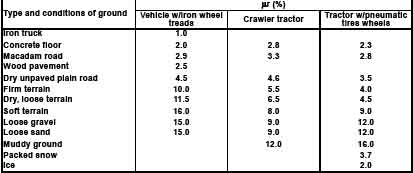
When a vehicle is traveling on the ground or road, the retarding force of ground against wheels or tracks should take place. Such a resistance varies depending on the ground or road surface conditions. The rolling resistance is measured in the ratio to the vehicle weight and can be estimated by the following formula.
Wr = μr•G
Where, 
Wr: Rolling resistance (kg) 
μr: Coefficients of rolling resistance
G: Vehicle operating weight

The coefficient of rolling resistance can be selected from among those given in the table below, according to the ground or road surface conditions. The coefficient of rolling resistance can be selected from among those given in the table below, according to the ground or road surface conditions.


In a crawler tractor, too, the rolling resistance should vary depending on the type of applied soil. The representative values of rolling resistance, however, are taken into account in preparing the curves for drawbar pull and hauling performance of crawler tractors. Therefore, the varying rolling resistance may practically be ignored.

Conditions
- Uphill traveling
- Traveling on flat, level surface
- Downhill traveling
Haul resistance
- Rolling resistance + grade resistance
- Rolling resistance.
- Rolling resistance – grade resistance

Example (6) What is the hauling resistance against the D60-6 tractor going uphill at 4° in a dry, loose terrain, while pulling an RS08 scraper with maximum load?

Solution: 
The gross weight of the RS08 with maximum load is 18870 kg.
The rolling resistance factor is 0.045. 
Thus, the rolling resistance is 0.045 × 18870 = 850 kg
The weight of the D60-6 tractor is 12550 kg.
The gross weight of the RS08 is 18870 kg.
Then, the total weight of both machines is 31420 kg
Consequently, the grade resistance is 0.07 × 31420 = 2200 kg.
Thus, the hauling resistance is 850 + 2200 = 3050 kg.

SUMMARY AND APPLICATION
1. Summary


2. Application
Example (7) Assume that the D65 tractor is used to pull a wheeled wagon (the empty weight: 17 tons) with a 50-ton load in a dry, loose terrain. What are the operating gears and the corresponding approx. travel speeds available on a flat, level ground? What is the degree of a hill climbable under the same condition?

Solution: 
The rolling resistance
Weight of the wagon (empty): 17000 kg 
Payload: 50000 kg
Total weight: 67000 kg 
Coefficient of rolling resistance: 0.045
Consequently the rolling resistance against the wagon is 67000 × 0.045 = 3015 kg

TRAFFICABILITY
Operating efficiency of a construction machine depends largely on the ground surface on which the machine travels. In clay, loam or clayey soil high in water or moisture content, the bearing force of soil is low and a ''kneading'' phenomenon is liable to occur. Consequently, there are cases where a construction machine cannot be operated because of the type and conditions of soil. The degree of the traveling capability of a construction machine is called the traffic-ability.

In general, traffic-ability is indicated by a cone index No. (The method of measuring a cone index No. will be
described later.). The larger the cone index number becomes, the higher the traffic-ability of the machine will become. In other words, on the soil larger in cone index No., a construction machine will be able to travel easier. The minimum cone index numbers required for various types of construction machines to perform digging, hauling operations, etc. are given below.


NOTE:
In determining a cone index, apply the cone penetrometer at 3 or 4 points at least to average the variations in the measured values.

* Cone index numbers (qc)
A cone index number is measured by means of a cone penetro-meter in a cone penetration test.
A rod with a cone at the tip is pushed into the soil by hand.
The pressure required to advance the cone at a slow constant rate is known as the penetration resistance.
The penetration resistance is read out on the dial gauge.
Thereby, the shearing strength of soil can be estimated.
Then, a cone index number can be obtained by referring the estimated shearing strength to the conversion table attached to the meter.

Earthmoving Data

SOIL CLASSIFICATION FOR EARTH-MOVING OPERATIONS
Various classifications have been established properly for soil depending on the purposes of earth-moving operations. Generally speaking, however, detailed classifications of soil are not required for the ordinary earth-moving operations.

Rather, attention is required to be given to whether the soil to be handled is of special ores or contains special
clay minerals. Hereinafter is described the knowledge necessary for earth work planning prior to such operations as digging, loading, hauling, pushing (spreading), rolling compaction, etc., on ordinary terrain.

* Data (figures) to be given hereinafter vary largely depending on various operating and environmental conditions. Consequently, before starting the earth work, tests should be conducted to obtain correct data for operations.

Some knowledge of the weight data per unit volume of materials of their major ingredients is important for their handling or hauling in mines, etc.. The specific weight data of some major types of soil and ingredients are given below.

WEIGHT DATA OF MATERIALS


Hauling Performance of Construction Machines
HAULING PERFORMANCE OF CONSTRUCTION MACHINES
INTRODUCTION
"What Model or type of a tractor is most suitable to pull this trailer?" "Is this bulldozer capable of going up this hill while pulling that scraper loaded full?" In order to give explicit answers to these questions, it is necessary to have the right understanding of the hauling performance of vehicles.


For easy understanding, let us explain the hauling performance with the following machine capabilities and
related elements.
(1) The inherent machine capability
(2) Elements limiting the inherent machine capability
(3) Machine capabilities required for earthmoving operations

INHERENT MACHINE CAPABILITY
1. What is the inherent machine capability?
a) Output power
The engine horsepower of a construction machine is the most essential power of those developed by the machine itself. This can be estimated by multiplying one element (traction force) by another element (a travel speed). Accordingly, where the engine of a machine develops a rated power; the smaller the travel speed, the larger the traction force or drawbar pull will be. On the contrary, the larger the travel speed, the smaller the drawbar pull.

b) Gear-shifting
Gear-shifting is effected to determine the optimum drawbar pull and travel speed required for accomplishing a given job. Therefore, a machine has several gears to be selected by shifting for the optimum travel speed.

2. Direct-drive type tractor
The table below gives the drawbar pull and travel speeds of a direct-drive type bulldozer.


The rated drawbar pull is such a traction force that can be developed at the rated engine power and the rated revolutions (rpm). The rated drawbar pull is normally estimated by taking into account the travelling resistance (which will be explained later) and the mechanical loss of power in its line from the engine to the sprockets.

The maximum drawbar pull is the maximum traction force that can be developed by a machine and is estimated from the maximum engine torque. In other words, the maximum drawbar pull of a machine can be developed by the lugging ability of its prime mover and is practically obtained in a low gear. Consequently, the maximum drawbar pull is shown only at F1 on the specifications.

3. TORQFLOW-drive type tractor
In a TORQFLOW-drive type tractor, the relationships between the travel speeds and drawbar pull are obtained from the combined performance between the engine and the torque converter. In a TORQFLOW-drive machine, it is difficult to relate both the drawbar pull and travel speeds directly to the engine revolutions. Thus, the hauling performance is indicated by curves. The graph at right gives the hauling performance curves of the TORQFLOW-drive type bulldozer.

ELEMENTS LIMITING THE INHERENT MACHINE CAPABILITY
1. What are the elements limiting the inherent machine capability or power? These are;
a) Traction between the undercarriage (tracks or wheels) and the road surface.
b) Altitude
Altitude in b) will be described in a separate issue and herein is examined the problem of traction between the undercarriage and the road surface.

2. Traction between the undercarriage and road surface
"When a motor vehicle cannot be moved due to slipping on the snow-covered road, what should be done to move the vehicle?"
The answers are;
Solution
(1) Add load to the driving wheels.
(2) Install chain to the wheel tires or replace the tires with the spiked type.
(3) Scatter sand or spread straw mats on the road surface.
Reason
(1) The traction force is increased with the added load.
(2) The undercarriage is made so as to develop more traction.
(3) The critical traction force is increased by the higher coefficient of traction.

The above facts can also be applied to a crawler tractor. Now, let us look at the coefficient of cohesion and the critical traction force or traction used in the above table. The critical traction is the maximum traction available depending on the cohesive condition of the road surface. This can be estimated by the following formula.

MACHINE CAPABILITIES REQUIRED FOR EARTHMOVING OPERATIONS.
1. What are the elements limiting the machine capabilities required for earthmoving operations?
When a truck is traveling on the road or going uphill, the following phenomena will be encountered as a matter of course.

Phenomenon
(1) The travel speed of a truck with load on the flat road should vary when the same truck with the same load travels on the rugged or rutted surface.
(2) When traveling on the flat road or going uphill in the same operating gear, the travel speed should vary as a matter of course.
Influential element
(1) Rolling resistance
(2) Grade resistance

2. Rolling resistance
When a vehicle is traveling on the ground or road, the retarding force of ground against wheels or tracks should take place. Such a resistance varies depending on the ground or road surface conditions. The rolling resistance is measured in the ratio to the vehicle weight and can be estimated by the following formula.
Wr = μr•G
Where, 
Wr: Rolling resistance (kg) 
μr: Coefficients of rolling resistance
G: Vehicle operating weight

The coefficient of rolling resistance can be selected from among those given in the table below, according to the ground or road surface conditions. The coefficient of rolling resistance can be selected from among those given in the table below, according to the ground or road surface conditions.


In a crawler tractor, too, the rolling resistance should vary depending on the type of applied soil. The representative values of rolling resistance, however, are taken into account in preparing the curves for drawbar pull and hauling performance of crawler tractors. Therefore, the varying rolling resistance may practically be ignored.

Conditions
- Uphill traveling
- Traveling on flat, level surface
- Downhill traveling
Haul resistance
- Rolling resistance + grade resistance
- Rolling resistance.
- Rolling resistance – grade resistance

Example (6) What is the hauling resistance against the D60-6 tractor going uphill at 4° in a dry, loose terrain, while pulling an RS08 scraper with maximum load?

Solution: 
The gross weight of the RS08 with maximum load is 18870 kg.
The rolling resistance factor is 0.045. 
Thus, the rolling resistance is 0.045 × 18870 = 850 kg
The weight of the D60-6 tractor is 12550 kg.
The gross weight of the RS08 is 18870 kg.
Then, the total weight of both machines is 31420 kg
Consequently, the grade resistance is 0.07 × 31420 = 2200 kg.
Thus, the hauling resistance is 850 + 2200 = 3050 kg.

SUMMARY AND APPLICATION
1. Summary


2. Application
Example (7) Assume that the D65 tractor is used to pull a wheeled wagon (the empty weight: 17 tons) with a 50-ton load in a dry, loose terrain. What are the operating gears and the corresponding approx. travel speeds available on a flat, level ground? What is the degree of a hill climbable under the same condition?

Solution: 
The rolling resistance
Weight of the wagon (empty): 17000 kg 
Payload: 50000 kg
Total weight: 67000 kg 
Coefficient of rolling resistance: 0.045
Consequently the rolling resistance against the wagon is 67000 × 0.045 = 3015 kg

TRAFFICABILITY
Operating efficiency of a construction machine depends largely on the ground surface on which the machine travels. In clay, loam or clayey soil high in water or moisture content, the bearing force of soil is low and a ''kneading'' phenomenon is liable to occur. Consequently, there are cases where a construction machine cannot be operated because of the type and conditions of soil. The degree of the traveling capability of a construction machine is called the traffic-ability.

In general, traffic-ability is indicated by a cone index No. (The method of measuring a cone index No. will be
described later.). The larger the cone index number becomes, the higher the traffic-ability of the machine will become. In other words, on the soil larger in cone index No., a construction machine will be able to travel easier. The minimum cone index numbers required for various types of construction machines to perform digging, hauling operations, etc. are given below.


NOTE:
In determining a cone index, apply the cone penetrometer at 3 or 4 points at least to average the variations in the measured values.

* Cone index numbers (qc)
A cone index number is measured by means of a cone penetro-meter in a cone penetration test.
A rod with a cone at the tip is pushed into the soil by hand.
The pressure required to advance the cone at a slow constant rate is known as the penetration resistance.
The penetration resistance is read out on the dial gauge.
Thereby, the shearing strength of soil can be estimated.
Then, a cone index number can be obtained by referring the estimated shearing strength to the conversion table attached to the meter.